Phosphoenolpyruvate (PEP) is an essential precursor for the biosynthesis of aromatic compounds, yet its intracellular availability is diminished when it is irreversibly converted to pyruvate by the phosphotransferase system or by pyruvate kinase. This limitation can be mitigated through the ATP-dependent reconversion of pyruvate to PEP, a reaction catalyzed by phosphoenolpyruvate synthase, encoded by ppsA. Overexpression of ppsA thus restores the PEP pool and supports increased flux toward aromatic pathway intermediates [134].
Another strategy to augment the PEP pool is to regenerate PEP from oxaloacetate (OAA) [134].
In wild-type Escherichia coli, approximately half of the cellular phosphoenolpyruvate (PEP) pool is diverted to glucose uptake and phosphorylation. Consequently, inactivation of the phosphotransferase system (PTS), which mediates glucose transport and concomitant phosphorylation, has been employed to conserve PEP and redirect metabolic flux toward target products [135].
The PEP pool can be increased by silencing the carbon storage regulator A (CsrA), which normally promotes the production of pyruvate kinase (pykF) while inhibiting the synthesis of PEP carboxykinase (pckA) and PEP synthase (ppsA) [342].
phosphoenolpyruvate
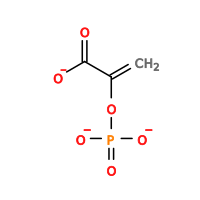
Description
Chemical Formula:
C3H2O6P
Molecular Weight:
165.019 Daltons
Monoisotopic Mass:
167.9823744031 Daltons
SMILES:
C=C(OP([O-])([O-])=O)C([O-])=O
InChI:
1S/C3H5O6P/c1-2(3(4)5)9-10(6,7)8/h1H2,(H,4,5)(H2,6,7,8)/p-3
InChIKey:
Synonyms
- PEP
- 2-(phosphooxy)- 2-propenoate
- Phosphoenolpyruvic acid
Databases
MetaCyc:
PHOSPHO-ENOL-PYRUVATE
RefMet:
Phosphoenolpyruvic acid
BiGG:
pep
HMDB:
HMDB00263
ChemSpider:
2907208
CAS:
138-08-9
KEGG:
C00074
PupChem (SID):
3374
CHEMBL:
CHEMBL1235228
PDB-CCD:
PEP
3DMET:
B00019
NIKKAJI:
J9.706C
Seed:
cpd00061
MetaNetX:
MNXM73
KNApSAcK:
C00000798